6.15.2009

Dead and Gone

Dead and Gone is quite a testament as to how entranced I am by this series of novels. I was quite content while reading it to accept whatever Charlaine Harris tossed in, and it wasn't until after I set it down that I realized this one wasn't quite up to par. Granted, there were a few points along the way where I arched an eyebrow at some choices, but I had to sit and muse on it before I recalled a few continuity errors and questioned not just choices, but judgment.
Of course, if you're a fan of the series, I think you'll be entertained. The world is about to be rocked with the information that vampires are only the tip of the iceberg when it comes to the supernatural world. Weres and shifters are next, adopting the tactics of the vampires by broadcasting their revelation on television, with local representatives to break the news. And while most people seem to take this okay (though Arlene unsurprisingly freaks out), a few incidents do occur. Sam's mother is shot by his step-father (though she survives), but it's a few days later when what looks like a truly terrible hate crime is committed -- Jason's estranged and pregnant werepanther wife is found crucified outside of Sam's bar. If you're getting faint with that one, then beware -- this is perhaps the bloodiest book to date in the series, because the fae are at war, too, and Sookie is a prime mortal target for enemies of her great-grandfather. Of course, there is some progress in the romance area -- if Eric tricking Sookie into "marrying" him can be called progress. He does it with good reason, though... the act binds her to him so no other vampires (say, the new establishment that's taken over Louisiana) can simply stake a claim and take her off. Which is what the FBI might have an idea to do, too, as they show up on Sookie's doorstep with questions about how she found survivors after the vampire summit explosion.
The plot moves quite quickly along, but honestly, I think we rushed into the whole fairy plotline. It seems that Harris herself is trying to pull the plug on things there, too, but I can't tell if that's her way of wrapping up a story in the plotline or the whole series. Anyone know how many books we're planning on having here? As many as we can justify Sookie waffling between Bill and Eric? Because aside from a brief cameo, Quinn's bowed out of the running, even if his dismissal wasn't quite substantial enough as one might like. Of course, don't get me wrong. I find the vampires more interesting myself, though a happily ever after will hardly come from that direction, particularly as Harris has asserted that Sookie herself will never become a vampire. Eric's the main beau in this book, though you can tell that things certainly aren't tied with a pretty ribbon, no matter how good the sex might be. Sookie skirts some relationship discussions and Eric might not be passing muster in terms of protecting the woman he's worked so hard to have pledged to him. (Though really, if Sookie was in such a strong place with the vampire and the were community, she would have been a bit better protective and no one needs to go to the post office that much.) Eric's a strong character in the beginning of the book, but there are parts where I'm worried he's morphed a little into what romance readers might want him to be -- for instance, him spilling his life story to Sookie while they sit in Fangtasia when earlier in the series, it was cited that he couldn't remember much. It makes him seem human and vulnerable. Tricking Sookie into the pledge and sending sexy cards, that I can see -- but the admission that he discovered the spell that sent him amnesiatic and reeling to Sookie was a curse that he would be close to his heart's desire without ever realizing it... well, we'll see how this goes. I'm not counting Bill out of the running just yet (and neither is the cover illustrator, for that matter, as Bill still has his place asserted there).
I also wasn't thrilled with the way that every single darn still-living character that we've come across seems to pop up in this book for just a brief moment. Things weren't terribly streamlined here, but then, if you're on top of things (for instance, say you had finished reading the other eight books in the immediately preceding seven days), then it's not like you'd forget who anyone was. It does mean, however, that the main supporting cast is not really given enough space. Then again, I can't get enough Pam (I know she's supposed to be blonde, but in my head, she's Joan Holloway/Christina Hendricks from Mad Men) and I'm ready for Sam to make a real bid for Sookie beyond his quick kisses.
And now that I've gotten through all of the books, what am I supposed to do while I wait for the next installment? I've already hunted down all of the short stories that Harris has written that feature Sookie. Sigh. Well, I suppose that's just as indicative of how I've been won over by Sookie Stackhouse. I'll forgive a few inconsistencies in the long run, but let's hope Harris's proofreaders do a better job on the next one. It's too fun a series to suffer at the hands of such annoying details, but those can certainly cut into one's enjoyment.
And now, I shall sit and twiddle my thumbs, reading books that have nothing to do with werewolf politics, fairy torture, or fangbangers. Sigh.

6.14.2009

From Dead to Worse

Book number eight... which means I've reached the end of the mass-market paperbacks and the next will come with a hardcover price tag. Ridiculously enough, I was rather thrown with this one in the beginning, because my copy has a different font set than all the others. And I'm still not quite sure what to make of the cover (even though it's pretty obvious for all the others), as Bill takes a bit of a backseat, but his presence on the cover seems to indicate he's a big player.
We're back in Bon Temps after the disaster explosion at the vampire summit that nearly killed everyone -- and no one seems to have walked away without their scars. As if the repercussions of that weren't enough to deal with, Charlaine Harris moves full speed ahead on tossing in a whole host of new complications and plot points. Quinn is MIA (though we know he made it out), leaving Sookie in the lurch and wondering why he isn't in contact. Bill tells her that he's still in love with her. (No surprise.) And while it's been quite some time since book four, Eric finally has a glimmer of memory about his time that he and Sookie spent together. On the non-romance front, Sookie acquires a new houseguest when Amelia's witch mentor comes to stay, and Amelia's dad visits to drop the bomb-shell that he knows Sookie's deceased cousin Hadley's ex-husband... and apparently, there's a baby. Oh, and we meet Sookie's great-grandfather, a prince of the fae who warns Sookie to be on her guard in case people try to hurt her to get to him. Like she needed another host of supernatural enemies. Of course, the weres and the vamps are a little busy at the moment, dealing with their own internal wars.
This one is so not a book for someone who just wants one clear storyline. Big things are happening to change the entire supernatural world... and Sookie seems to be mixed up in it all.

6.12.2009

All Together Dead

It's book seven and Sookie is attending the vampire summit in Rhodes in the service of Sophie-Anne, the vampire Queen of Louisiana. Hurricane Katrina has hit, devastating New Orleans and a good part of Louisiana (though Bon Temps is fine), which has weakened Sophie-Anne's position... and at this summit, there's the possibility that she'll be standing trial for the murder of her husband, the King of Arkansas, who met his end after initiating a coup against his bride in the last novel. Also at the conference, we have were-tiger boyfriend Quinn, vampire Eric (who's still trying to figure out things with Sookie), vampire Bill (also known as Nameless since the revelation that his relationship was Sookie started by order of the Queen), Barry the Bellboy (the only other telepath that Sookie has ever met), and a host of other vampires from previous books. We picked up Amelia in the last book (the witch who turned her one-night-stand Bob into a cat after some adventurous sex went definitely wrong) and she's settled in as Sookie's housemate who's there to hold down the fort in Bon Temps. Oh, and apparently there are other dimensions from which people can be summoned? Seriously, the cast keeps growing... to the point where the reader must wonder if we're getting everyone together for a big event where some folks end up dead. And really, people/vamps ending up dead is something you can usually count on.
If you thought Sookie got into trouble with a few vampires, imagine a whole convention center full of them. Sookie might be there as a "human Geiger counter" to the Queen so she can do some business deals and clear her name, but naturally there are other forces to be fought against. Sookie and Barry must figure out what's going on before it's too late, daylight or no.
Side note: I have to confess. I'm not crazy about Quinn. The image of him simply isn't sexy. If Sookie needed a non-vampire guy, what was so wrong with Sam? I'm liking how conflicted Eric is about his connection to Sookie (and we get an interesting turn with this), and while Bill is clearly sorry, Sookie isn't getting over his betrayal quickly.

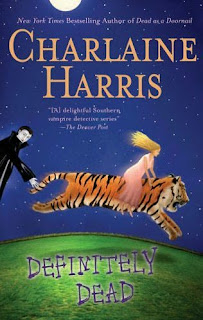
Definitely Dead

Before you read book #6, I recommend you pause and do some sleuthing to save yourself the "wtf?" moment that happens when you realize that you're missing some information. What you're looking for is a short story called "One Word Answer" that was published in a collection called Bite, and in this story, you learn about Sookie's cousin Hadley. Hadley became a vampire and then met her final death, and Sookie has been named the sole heir. In addition, during her short time as a vampire, Hadley became a favorite of the queen of Louisiana. I say all this because I was pretty miffed when I was reading book 6, as this information is summarized as though it has happened in the series and it was most definitely not in one of the novels. If you google the title and author, you can find a pdf somewhere.

In any case, the plot of book six rests on this information. Sookie goes to New Orleans to pack up Hadley's apartment and finds a bit more than she bargained for. Quinn (the were-tiger) is back and even manages to have a semi-normal date with Sookie (before it's interrupted by a werewolf attack). The Pelt family continues to persist in trying to discover what happened to their daughter. The Queen of Louisiana has just married the King of Arkansas, but things aren't exactly going smoothly. And while Eric has all the information about what happened while his memory was lost, he still can't quite figure out what Sookie means to him now, which pushes him into making Bill reveal some rather major information.
We're definitely seeing a shift away from Sookie's absorption with her relationships (not like she was ever only boy-crazy, but she's become a bit older and wiser), and while we certainly aren't discounting the fellas, Sookie is becoming more and more involved in the supernatural world in her own right as the Queen calls upon her for her assistance.
Trivia: evidently Charlaine Harris had finished this manuscript just prior to Katrina, and considered changing it as a result of the hurricane, but because of the season in which it takes place, she left this novel as it was and, instead, worked Katrina's destruction into the next.

6.11.2009

Dead as a Doornail

I promised myself that at the end of book four, I'd take a breather before I picked up another Sookie Stackhouse book. That breather apparently consisted of the five hours between me finishing book four on my lunch break and my stopping by Barnes & Noble on my way home from work. And now I've finished five books in five days.
Book five of Charlaine Harris' Sookie Stackhouse novels feels a little different from the first four. Things aren't focused on past boyfriends quite as much (though Sookie seems to be enjoying keeping information from Eric, who forgets everything that happened while he stayed at her home) and we're also not quite as focused on present loves to the same degree, either. A couple of kisses, sure, but we don't have nearly the same scenes that the last few books included. Instead, we're getting further into the politics of supernaturals. After Jason's ordeal in the last book, Sookie's waiting for his first time changing with the full moon. In addition, there appears to be someone shooting random people around town, including Sam -- though it's not so random when you know that all the victims are supes. Sookie gets Eric to loan her a vampire bartender to pick up the slack at Merlotte's, and the new vamp seems to be a very charming pirate. Alcide practically tricks Sookie into giving her allegiance to his father as a new packleader candidate by being his date for a packleader funeral. And oh yes, Sookie's house partially burns down. At least she seems to have picked up a fairy godmother. A lot is going on, but if you don't know that Sookie's up to the challenge by now, then where have you been for the past four books?

6.09.2009

Dead to the World

The blonde vampire on the cover (rather than our usual tall, dark and pale one) is a big clue before opening this book that things are changing in Sookie's romantic life. This, the fourth book, opens on New Year's with the fact that she and Bill are no longer together, and since his work is taking him to Peru, that leaves Sookie single... which is when she comes upon Eric on a dark night, apparently with no memory of who he is. His mind has been wiped by a strong coven of witches that have moved into the area, demanding a piece of the vampire's businesses, and as if that wasn't enough, Sookie's brother Jason has gone missing. Her worry, however, is not so overwhelming that she can't appreciate the kinder, gentler (but not too gentle, lest we forget one of the steamier scenes in this series that occurs in this book) Eric that's staying hidden in her house while the witches look for him everywhere.
In addition to witches, we get more shifters in this book, and a few that we already knew about are back on the scene. (Unsurprisingly, Sookie acquires YET ANOTHER supernatural admirer.) There's almost too many supernaturals around for my taste -- I kind of like watching the uncomfortable reactions of the normal townfolk to the other beings in their midst. So it's not even that important to note that we're staying put in Bon Temps, rather than run around other southern states, because we get so few interactions with the locals.
And yes, this would make four books in four days. But here begins my self-imposed breather from the Sookie Stackhouse novels. Let's see how well I keep to that.

Club Dead

I suppose I knew it was inevitable -- the book in the series where something comes between them and the heroine has to do without the hero for a while. Another quick read, this one introduces us more fully to other supernatural creatures, like werewolves and shape-shifters. From the get-go, Sookie and Bill are a little estranged as work calls him out of town, but soon Sookie learns that Bill is definitely in danger and possibly dead (dead again? dead for good?) already. So Sookie is off to Mississippi to collect yet another supernatural suitor, information on Bill's whereabouts, and more bruises. Seriously, do we have to beat this girl up in every single book? Of course, her emotions are getting a little battered in this one, too, as it's possible that Bill has been unfaithful, but Sookie is still intent on finding him.
In this, the third book in the series, Charlaine Harris manages to entertain and I no sooner set this one down than I picked up the fourth.

6.08.2009

Living Dead in Dallas

Sure enough, I finished writing my quick review of Dead Until Dark and then started this, the second book in Charlaine Harris's Sookie Stackhouse novels. Similar to the first in terms of fun, though we spend a decent amount of time in Dallas, where Sookie has been "loaned out" to help them discover a kidnapped vampire. This time, we explore more of the vampire world... hotels that cater to the undead, regional hierarchies, the anti-vampire groups, a vampire so old that he's ready to "meet the sun" and die, etc. We get more of Eric in this one, which was intriguing. He's not behaving how I would have expected, but he's pretty amusing towards the end of the book. And there felt like there was less sex in this (though there was a pretty intense scene at one point), and there is a storyline involving an orgy, so maybe I'm mistaken.
I finished this one in a couple of hours and while I don't think it was as good as the first, it's hard to really define what makes one of these books any better than another. And I may have already started the third, so clearly I'm still hooked.

6.07.2009

Dead Until Dark

A couple of very literate friends of mine took me into their confidence recently. Their secret? They couldn't stop reading Charlaine Harris' Sookie Stackhouse series of vampire novels. They knew it was wrong but they couldn't stop. So I wasn't entirely surprised when, for my birthday, they made a gift of the first four books, battered and worn the way that mass-market paperbacks should be. Less than a week after that, stuck at home with a cold, I started this, the first book. I was only a few pages in when I took a sip of tea and then came across the phrase "fang-banger," and I nearly spat out my drink. After a full minute of laughter, I sighed and knew that I, too, had fallen victim to this series.

Sookie Stackhouse works as a waitress in a bar in small-town Louisiana, living with her grandmother and keeping few friends. She never dates, even though she's in her mid-twenties and is reasonably attractive. Why? Well, Sookie is seen as a bit of a local crazy because she can read minds (which she and some townsfolk refer to as her disability, if they refer to it at all). Since she's mostly concentrating on keeping out the multitude of thoughts around her, she likes her job at the bar because it keeps her busy. Then, one day, the vampire arrives and her life changes. (Now, you might think that the arrival of a vampire in town would be cause for alarm, but apparently vampires have been legally recognized in this novel's world. While they're not exactly a common occurrence -- especially in small-town Louisiana, but then, they are close to New Orleans -- they aren't cause for panic, either. I thought of likening it to the civil rights era, as though a black man walked into a white bar, but no, the vampire is cause for even less of a stir. Sure, there's some curiosity and a bit of prejudice, but not nearly as much as one might think.) For Sookie, the vampire's arrival is even more meaningful because finally, here is someone whose thoughts she cannot hear, and she's immediately smitten.

There are a few things that struck me about these. (1) It's the first time in a long time that I've read a novel where the heroine is not well-educated. I certainly wouldn't say she isn't smart, but she makes no excuses for her lack of education and the fact that she enjoys her job as a waitress. I'm not quite sure what to make of it yet. (2) These are incredibly more sexual than I was expecting. I haven't watched True Blood, the series based on these, and I didn't check out anything about them before I started to read, so that's my own fault for stumbling blindly into it there. (3) I had to look up what a banana clip was and why it was so important for the author to keep citing it so specifically as what Sookie was sticking in her hair... and I still don't understand why it was so important.

Now, these are not deep novels. (Even though I've only read the first at this point, I feel I can still make this statement without it coming back to haunt me.) There's a reason why they feel so at home in their mass-market paperback binding. They're light and fun reading, perfect for vacations or for those stuck at home with a cold. I finished this in a matter of hours and feel sure that I'll get to the next one soon. But there's no doubt, I'll definitely be continuing to read the series.

And one more thing. "Fang-banger"? The whole series might have been crafted around this phrase and I wouldn't care. It's kind of priceless.

5.26.2009

Sepulchre

Have you ever heard/read of the word "juddered"? Not jetted, not jarred, not shuddered... "juddered." Used in the context of this novel (and it was used twice), it was something like "juddered to a halt." Now... I've never seen this word before, but it certainly made me judder to a halt. Though Dictionary.com suggests "judder" means "to vibrate violently," which means I'm not quite sure it means what Mosse wanted it to mean, but if anyone has more info on this, please pass it along. I am totally willing to have my vocabulary expanded.

But why do I mention this as the first point in my review of Sepulchre? Well, not because Mosse's writing is jarring or because it makes me slam on the brakes and quickly end something. It's more because both Mosse novels have let me go along for a while, but then ultimately caused me to tilt my head and ask if perhaps we couldn't have had one more pass with an editor, because a few things could use some review and tightening up.

Don't get me wrong, clearly I enjoy Mosse's novels. I sought this one out as soon as I found it in paperback and I know that I'll read whatever else she writes. The best part of a Mosse novel is the beginning... as you meet the characters, ease into the story, and start absorbing the time period. Kate Mosse writes quite well as a historical fiction novelist. Note: I actually do mean a historical fiction novelist here, not a historical romance novelist, as so many female historical writers seem to be these days if there's any hint of romance in the book. And I also want to point out that she is, indeed, a novelist, in the sense that her plot line takes precedence. Mosse clearly does her research when she invests herself in a time period and she's in love with the south of France, which you can also tell from her descriptions of the country. Mosse crafts intricate plot lines, embellishes with beautiful historic detail, and conjures likable characters (though her modern characters are not always quite as fleshed out as the period characters, and they often feel too full of the echoes of the past to have enough personality of their own). But ultimately, it's this ability that makes me expect a little more from her when we keep moving through the novel. These books are suffused with suspense and tinged with the supernatural, but about two thirds through Sepulchre (and, for that matter, Labyrinth), I set the book down with a sigh because I was getting a little tired of the build-up to an ending which I'd already figured out. I won't give anything away, but trust me, you'll figure it out long before the book gets there.

If you have read Labyrinth, then Sepulchre's format will seem familiar with the dual plotline format. (Indeed, even a few characters will be familiar to you.) In the late nineteenth century, a brother and sister have traveled from Paris to visit their aunt in a small town outside of Carcassonne. This aunt has inherited her husband's estate upon his death, a house that has a great many dark and mysterious legends surrounding it. Here we have secret lovers, murder, feigned deaths, desperate attempts to flee evil villains, duels, and dabblings in the occult. In the twenty-first century, we have a young woman who is trying to finish a book on Debussy and, while she's at it, piece together some family history of her own. Here we have the beginnings of a romance, murder, a not-quite-evil-but-mostly-just-led-astray villain, and some more tame dabblings in the occult. Unsurprisingly, these times are tied together and the modern era's quest to discover what happened in the past will also attempt to right any wrongs leftover.

Ultimately, I would say that as long as you're not expecting too much of this novel and you enjoy period novels, then there's a high chance that you'll be pleased with this. Mosse clearly has the researcher's need for detail and that always makes me feel like we're starting on the right foot, but something still needs to come together with the gothic novel part, whether that's inserting a real twist or what. I still finished feeling like I wanted something more, and not just another Mosse novel, though I'll be looking for that, too.

5.04.2009

Forever Amber

It was the evening following a wake for a family friend and the immediate family (including those of us deemed honorary family) was gathered about the kitchen table, talking and watching the number bottles of wine begin to outnumber us. Not normally a crowd to show deference to any one person when it comes to directing the conversation, it seemed like the widow was enjoying this unusual honor and for whatever reason, she led us to Forever Amber. She was explaining just how scandalous this book was when she and her girlfriends read it in their youth; they shared a dog-eared copy and circulated between them to read again and again. The wicked sparkle in her eye told us more than enough (though despite our protests, she went on), and within a week after returning home, I found a stack of Forever Ambers at the Strand -- so I sent one off to all the women who had been part of our conversation as a memento of quite an evening. But once the gifts were sent off, I didn't actually pick up my own copy for quite some time. (It is a little shy of 1000 pages, after all, and even with a book that isn't in hardcover, that's a bit unwieldy for subway reading.) I shelved it, amused by the script on the spine and wondered where it would attract little notice from friends. It was only recently, wishing I had a trashy novel handy with which to spend an afternoon, that I plucked Forever Amber from its tucked away corner on the shelf and found myself with a romance novel that might have been written in the 40s, but had all the feel of a contemporary historical romance epic. Clearly, here was the grandmother (grand madam?) of a literary tradition...

Forever Amber was published in 1944. The published version was Kathleen Windsor's fifth draft of the novel... and those 972 pages represent only ONE FIFTH of the original manuscript. Fourteen states banned the novel, classifying it as pornographic, but sex wasn't the only issue. From the Independent's obit on Kathleen Winsor: "The Attorney-General of Massachusetts, in explaining his reasons for banning the book, said that he had counted 70 references to sexual intercourse, 39 illegitimate pregnancies, seven abortions, 10 descriptions of women undressing in front of men and 49 'miscellaneous objectionable passages'." Of course, this only helped it become a best-seller. In its first week, 100,000 copies were sold, and went on to sell over three million copies.

The novel tells the story of Amber St. Clair, a sexual adventuress who makes her way up the ranks of 17th century English society by using her wits and her... ahem... other endowments. She sleeps with and marries men who can offer increasing amounts of wealth or better titles, ultimately reaching great heights in society, though with a rather sullied reputation. Early in the novel, she has her fortune told and is appalled when it suggests she will have many husbands and several children, for she only loves one man -- Lord Carlton. Lord Carlton is "responsible" for taking her away from her small country town to London (I have to use quotes because really, Amber's the one who's really responsible for it and she begs Lord Carlton to take her), and it is Lord Carlton that Amber loves and loses again and again throughout the novel. He swears from the beginning that he'll never marry her, but this doesn't stop Amber from clinging to her hope that one day, they will be together.

Now, you might suspect that with such a racy novel, perhaps we'll be dealing with a story where our heroine goes on a journey and learns something in life. Well, you'd be wrong. The title is rather indicative of what to expect... because Amber never changes from being a selfish creature who is willing to do anything to get what she wants, but she's unwilling to accept certain facts and realities. From country girl to actress to duchess, Amber is forever Amber.

Throughout this novel, I kept thinking about Gone with the Wind (that "other" historical romance of the late 30s/40s) and, unsurprisingly, it is frequently compared to that novel for many reasons, such as the presence of multiple husbands that are almost entirely being used (as opposed to being married for love or such nonsense) to get back at another man (who she never marries), and an ending that leaves you with a vague "wtf?" feeling. (Though I have a somewhat higher opinion of Scarlett than I do of Amber.) It's not that I feel cheated, necessarily, it's just that the ending made me question whether or not I was supposed to be judging Amber, for such a fate suggests that she's getting her comeuppance. I had never before felt like the book was passing judgment on her, so I felt rather thrown.

Even so, from the first chapter, you can definitely see the origin of every historical romance novel in the pages of Forever Amber. It's easy to see why it caused such a fuss at the time, and, once you set all the scandalous stuff aside, it's an interesting account of various historical events (the plague, the Great Fire of London, etc.). Of course, why would you want to set the scandalous stuff aside?

5.02.2009

Jane and Prudence

There's something quietly lovely about a Barbara Pym novel. It's a perfect rainy day read, as you imagine yourself in England... if you have a large chintz armchair, all the better. And while I don't think you need to adore Jane Austen in order to enjoy Barbara Pym, it probably helps, though there's something a little darker and more melancholy in Pym.

Jane and Prudence unsurprisingly deals with two Englishwomen named Jane and Prudence. (As a result, I was singing "Dear Prudence" over the three or four days where I was reading this.) Jane is a minister's wife who is a bit older than Prudence; the two met when Jane was her tutor at Oxford and their unlikely friendship stuck. Jane's husband has just taken over a country parish and Jane is more than usually aware of the fact that she's not a particularly good clergyman's wife. Nevertheless, they move into this parish with their eighteen-year-old daughter, Flora (who is about to head up to Oxford herself), and settle in to meet the locals and navigate the intricacies of a small country town. Prudence, meanwhile, lives in London; she's unmarried and while she is employed, she is not absorbed in academic work, which often leads the older women of their college back at Oxford to be at a loss for fitting Prudence into a particularly neat category, though Jane might say that she might not have her work, but "Prudence has her love affairs." And for the time, it does seem that Prudence has such a romantic nature as to be enjoying the attention of a man or fancying herself in love with another. Prudence's latest focus is her employer, a middle-aged man that does not seem particularly interested in her, beyond one day a while back when he used her Christian name and took her hand as they looked out a window. Jane (in a not-quite-focused way) tries to think of who might be suitable for Prudence in this new town.

Aside from scenes set at Prudence's office (where her spinster coworkers pay close attention to what time the tea should be brought in, and mild chatter about the two men in the office), the majority of the book is set in the country parish, where you have the usual assemblage of busybodies and village VIPs. As with all Pym novels, you're presented with women in a rather narrow life, struggling to find their niche or at least muddle through without one. It's highly representative of the post-war feeling of confusion that women of the age must have experienced as they balanced the desire to have work of their own just as they're expected to marry and start families. The intriguing thing, of course, is that it might not be exactly the same today, but it's easy to relate to the unsettled feelings as one tries to find a place in the world that feels like it fits.

It's easy to see why one might suggest Pym to those who enjoy Austen. Pym novels are, on the surface, easily summed up as novels about Englishwomen in the middle of the 20th century, often too smart for their surroundings, but without a means of focusing that intelligence as they become wives, mothers, or settle into their role as spinsters (for indeed, there is no real place for a single woman unless it is that of a spinster).

If you're looking for a quiet, lovely novel with some subtle social commentary and quite good character insight, then I suggest you try reading a Pym novel. The rainy afternoon and a tray with tea and scones are not required, but they certainly help set the scene.

4.27.2009

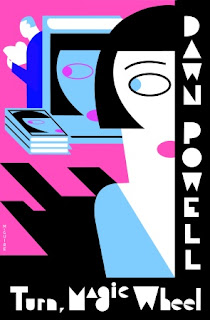
Turn, Magic Wheel

I received this book from a coworker as a gift nearly three years ago. Respecting both her and her taste, I was ready for a literary gem. Well, unsurprisingly, I intended to read it right away and then three years went by before it popped into my head for some reason or another (most likely because of the rather delightful cover which is rather memorable in my mind), and I started reading it without glancing at the back cover for a reminder as to its topic. My opinion holds firm -- this was quite a delightful book.

Turn, Magic Wheel is one of Dawn Powell's New York novels and she personally considered this her best work. The plot is this: Dennis Orphen has written a novel about a woman, left by her famous author husband -- cannibalizing the life of his friend, Effie Callingham, to do so. Effie is the first wife of Andy Calligham, who has since become a rising star in the literary world, and he left her several years before the start of our story. Despite that, Effie still lives in a world where she is still addressed as "Mrs. Callingham," though no one is deceived, except for Effie. Dennis takes few pains to conceal that his novel is about Effie and Andy Callingham, and our story almost immediately opens with Effie discovering his advance copy of the book, realizing that now the reality of her abandonment will be made public knowledge. This betrayal is one of many in the novel, and arguably, it isn't even the worst thing that one person does to another. A poignant and lovely novel, Turn, Magic Wheel is also a delightfully witty and wicked look at the New York literary scene.

The title of the book comes from Theocritus: "Turn, magic wheel / Bring homeward him I love" which vaguely outlines a bit of what is to be expected in this book. The action hinges on the fact that we spend a great deal of time talking about Andy Callingham, the famous writer (and modeled on Hemingway), but we're all waiting for him to appear, for only with his arrival can we sort anything out.

Powell has created wonderful characters, painfully and beautifully real. One frequently wishes to slap some sense into Dennis; he can be so curious about the lives of others, still be completely wrapped up in his own, and find himself totally flummoxed when the reality of someone else's life actually dawns on him. Somehow, this novel is both a biting satire and yet still an unconventional... I hesitate to use the phrase "love story," but there are elements of that, too.

Certainly, for anyone who loves New York and literature, I think they'll enjoy this novel. Dawn Powell writes about New York as if it's more than just a setting... it's another character, living and breathing around the others, with a life and hum and energy. I'm certainly looking forward to discovering more of Dawn Powell's work, and I'm quite in the debt of my former co-worker for exposing me to her writing.

Also, I might also direct you to a New York Times review of this book, published in 1936. I don't know why this delights me so... perhaps it's simply the idea of the NY Times actually bothering to put its book reviews from the 30s online, but it makes me quite happy.

4.26.2009

Death and the Penguin

For some reason, this book caught my eye ages ago, on a table in Barnes and Noble, and I picked it up and knew it would be a Great Book. Three years later, I tucked it into a suitcase and read it in one sitting on the train and while I certainly think it has incredible elements to it, the hype of having it tucked away for a few years meant that I had that sense of wanting something a bit more... but only upon initially closing the book. I don't necessarily read a great deal of existentialist literature, but I quite enjoyed this... particularly the writing style and the characters, and further reflection upon it only seems to improve the work.

The basic plot is this: Viktor is a semi-aspiring writer (who lacks ambition and inspiration) living in post-Soviet Kiev. His only true companion is his pet penguin, Misha. Why does he keep a penguin as a pet? Well, when the zoo could no longer afford to feed some of its animals, it gave them away to those who could (which is a true story). Viktor, having just broken up with his girlfriend, was a bit lonely, and so he took on Misha, and King Penguin. Now, this isn't a story with a talking penguin, so don't think we've gone there. No, Misha simply waddles around the apartment, a bit depressed and lost, so he and Viktor are somewhat alike as we start out in this novel. But then Viktor gets a job writing obituaries - obelisks as the book calls them - for those VIPs in their society who have not yet died, the idea being that these tributes will be on hand when they do. Of course, things aren't always what they seem and just when Viktor appears to find his life settling into something resembling the stereotypical dream of job and family, he discovers that his obelisks are being used as a kind of hit list.

I had tried to get this into my book club for discussion, but no one seemed terribly enthused, which leaves me to muddle through the questions it raises on my own. Naturally, my favorite parts of the novel are with Misha, who became so vivid in my imagination as he moved through the apartment and looked at Viktor with sad eyes. Viktor himself is an interesting character, vacillating between paranoid despair and an ignorant (but actively opting to be ignorant) and childlike contentment. Things tend to fall into his lap (the job, another man's daughter for Viktor to raise, a relationship with the girl's nanny) and he tends to simply accept them, make the most of things, and not question them. One cannot help but ask how much one tends to accept in his/her own life in a similar way as to Viktor... how much benefits us in a "no questions asked" kind of way, even if ours must certainly be a bit different. (When were you last paid $1000 for showing up at a funeral with a penguin?) But the only creature that Viktor seems to have a real connection with is Misha, who came about as a result of an active choice to take on a penguin from the zoo... though perhaps unsurprising since Misha is used as a mirror for Viktor himself throughout the story.

If I knew more about post-Soviet Ukraine, I'm sure I could have gleaned more from the relationship between the media, the government, and the mafia -- or at least beyond the obvious manipulations of them all upon each other. I mean, I was prepared for the drinking and the routine murder from simple historical stereotypes of this period of time. What I can determine is that there's certainly something to be said about entrusting your fate to the mafia rather than the government (which is perhaps why Kurkov's work was banned in Russia), as the mafia seems more capable of caring for you. It seems to make no difference which camp you're in, as life is just as precarious either way, but at least the mafia seems to have the funds capable of caring for your body if not your conscience. Some reviews have called the prose "cold", but I imagine it's simply apt as a voice representative of the Ukraine and its people. An absurdist humor, a resignation to certain goings-on in life, an emphasis on how it's better not to know too much...

No matter what, if I can somehow find Kurkov's other works, I'll certainly be quicker about reading those than I was this one. And you should waste no time in discovering this gem for yourself.

4.16.2009

The Song Is You

I must say, I was rather pleased with The Song Is You. It's not that I didn't expect to enjoy this, because I did, but I also expected to feel like it was missing a small something. That's how I felt about Prague and The Egyptologist, both works that I enjoyed, but ultimately finished feeling a teensy bit dissatisfied (and also feeling like they went on just a touch too long). No matter what, though, I still really enjoy Phillips' writing style -- which is why I keep reading his stuff. When LibraryThing listed The Song Is You as an early reviewer's option for the monthly books they offer for free, I threw my hat into the ring and snagged a copy. (Oddly enough, the day I received it in the mail, my friend who gets free books via a literary site that he runs, also offered me a copy, which I passed along to another friend.)

I began reading this without the faintest idea of the plot, beyond a vague knowledge that it must have something to do with music and a relationship. The title supplied me with the music idea and the cover (featuring a young man and a young woman) suggested the relationship bit. That's it. So perhaps I shouldn't summarize the plot, but suggest that you, too, should take a chance on this and just read and fall into it. Perhaps, but I won't. Instead, I'll provide a hazy sketch, because really, the plot is a bit hazy, too -- in a good way. Our main character is named Julian and the book focuses on his relationship to music in his life, and his relationships with two other women. To a great degree, the novel portrays people whose relationship to music can often be seen as a means of pushing back on actual human interactions and how music can be more than just the background soundtrack. The novel starts with a scene involving Julian's father at a Billie Holiday concert. Sure, this was the concert where his future wife and mother of his children was seated beside him, but above all, the siren and her music meant so much that it seems to overpower even the events set into motion on that night. Julian is instilled with a great respect for music, raised by a widowed father alongside an older and antisocial brother. He marries, he has a child, that child tragically dies, and his marriage essentially ends, though the final divorce decree has not yet come down. And then Julian is introduced to a new siren, an Irish redhead whose fame is growing, and they become involved in an intricate dance of longing for connection.

The book jacket calls one's attention to the fact that Phillips is a writer for people who both think and feel. And we all know that "think" can often mean "overthink." This particular book is a beautiful portrayal of characters who perhaps aren't looking for romance and meaning, but once it becomes an option, they are hungry to have it, but constantly overthinking in their attempts to create something perfect and potentially lasting.

I shall certainly be recommending this novel to those who have previously enjoyed Phillips' work... and to those who were not perhaps won over, I shall urge them to give it another shot with this, because I think Phillips has really done something remarkable here. The novel shows incredible growth, away from the somewhat arrogant youth of Prague, and while there is a certain indulgence to the melancholy of romance here, the emotions feel real and true. An excellent work, and I shall continue reading whatever Phillips puts out next.

4.08.2009

Smilla's Sense of Snow

Oh my goodness. I devoured this book... I actually had to keep it in a separate room so it would be out of my line of sight and I could prolong the reading experience.

A longer review will follow, but here's the basic plot.

In Copenhagen, a young Greenlander boy named Isaiah dies from falling off the roof of his apartment building. Smilla (our narrator and his neighbor, another Greenlander) sees his footprints in the snow and even while the police are ready to declare it an accident, she can tell from his tracks that something isn't right in that ruling. A child -- moreover, a child afraid of heights -- would not run so assuredly towards the edge of the roof. What follows is Smilla's determined search to understand how and why Isaiah died, which takes her far from Copenhagen's snowy streets and into the treacherous ice of Greenland.

3.31.2009

The Brief Wondrous Life of Oscar Wao

From the beginning, I was concerned about the hype surrounding Oscar Wao... to the point where I think I scaled back my expectations enough before reading it and ultimately, I was quite pleased with this novel. Don't get me wrong, it has flaws... but I enjoyed the experience of reading it and that makes up for a lot.

In general, the book is about the life of super geek Oscar Wao, who is overweight and obsessed with fantasy & sci-fi novels. He's always hopelessly in love with a girl, but has never been able to actually have a girlfriend. The novel is also about his family, who has possibly been cursed... this fukú has potentially been plaguing his family for generations... though the narrator also notes that it's possible this fukú is on most of the world since slavery and colonization and all that.

Above all, I think this novel really comes down to the narration. Talk about a voice! I quite enjoyed the narrator, even as I recognize some moments of disconnect, but for some reason, they didn't bother me as much as they bothered some other people. I mean, we get some small jumps in perspective, but from the beginning, we have a novel narrated by someone that we don't meet until a good while into the book -- Yunior (who was also a main character in another of Díaz's books, apparently). However, despite being a character, Yunior is also an omnipotent narrator, speaking with knowledge beyond what is possible for a character within the story to know. His narrative is filled with all the geek-infused knowledge of Oscar (even though Yunior is actually a jock and a ladies man), so there's a small question mark that pops up there. But for whatever reason, I just accepted it for the sake of enjoying the novel. Assume that it's part of understanding Oscar and without that knowledge (I was impressed when I could catch a few of the references myself), then the novel would slip into something more mainstream... and you wouldn't be able to appreciate how geeky the author must be in order to have all this knowledge.

Beyond the story that revolves around Oscar, you also have the focus on his family, which includes his sister, his mother, and his grandfather. I know very little about the Dominican Republic, but what I did know before reading this book all seemed to be focused on Trujillo... and so I didn't feel so amazingly confused, as a lot of this focuses on life during and after Trujillo in the DR. It's amazing how much influence this dictator has had on the art that now comes from those in the DR or with Dominican ancestry.

I heartily recommend this novel, even though I'm not entirely sure that the Pultizer was warranted... because for me, Pultizer seems to signify something so amazing... and usually something about the author, who should probably be a little bit more known, yes?

If you haven't read it, I suggest putting it on your short list. It's a very quick read and I don't think you'll regret it. Just try not to expect the world of it and accept it for being simply a good book.

3.29.2009

The Watchmen

This is my review pre-discussion with intense Watchmen fans. I'm sure that as a result of that conversation, my eyes will be opened to a few things and I might appreciate a few more details, but I'm also fairly certain that my opinions won't change much. The story is interesting and unique but I think that my view of the book definitely suffered as a result of hype. Not movie hype (because I know that's out in theaters now), but comic book history hype. This is the end-all be-all of comic novels, it seems. The original. The godfather. It clearly forged a new path in terms of longer, more complex and deeper comics. Everyone who has read this seems to worship it. The cover even touts it as one of Time Magazine's 100 best novels. Perhaps I wasn't in the right place for it? Here's what I will say.

The story is this. You have two batches of incredibly screwed up human beings who, for whatever reasons, are compelled to dress up and save the world. We call them "superheroes" even though they actually have no super powers (except for one guy, Doctor Manhattan, who isn't really a human being anymore as a result of the nuclear accident that gave him his powers... and he's blue). You might pause here and wonder, "wait, shouldn't we go into that whole psychology thing a bit more? Why do they do this?" Well... that's not easy to answer. You kind of accept that what spurs someone to feel like they want to "save the world" and don spandex is a bit darker than you might have otherwise thought, but for each character, it's a little different. (Side note... one of the cooler ideas is this: in this world, we won Vietnam and Nixon is still president. Like woah. But even though we won Vietnam, we're teetering on the brink of WWIII.)

But back to the characters. There's a first and a second wave of super heroes, the first of which has essentially retired/died off and the second that is a little out to seed, but are still bigger players in the current scene of things (though both play an equal role in the story, as we spend a lot of time trying to figure out everything that has happened in the past). Why are the "younger" heroes out to seed? Well, a law was passed that made their actions illegal (which resulted from a police strike against the vigilantes), thus forcing them into retirement. The book makes no secret of the fact that these people have to be a little twisted to do what they do. And "a little" twisted is putting it mildly for most of them. (See above.)

On to the plot, which is pretty simple. For some reason, a few of our masked vigilantes have been killed and it's suspected that there's a connection -- a "mask-killer" at work. Our book deals with the question as to whether or not there's a plot to kill masks AND, beyond the masks, whether or not the world is going to devolve into WWIII. Ultimately, the whole comic is more interested in its own style and storytelling (see the comic book within a comic book that was an interesting parallel illustration of losing one's sanity/humanity/values in the pursuit of one's treasured ideals) than developing an intricate plot.

The most interesting character for me was The Comedian. It's his death that spurs the plot, so I guess he would have to be the most interesting, as we spend a lot of time trying to "figure him out" to some degree. He's twisted and mean and clearly full of himself, but each time he entered into the story, I was more interested in what was going on. (Of course, knowing that Jeffrey Dean Morgan plays him in the movie, even before looking at the book, I knew The Comedian would die... because Morgan is always the guy who dies.)

I didn't like Rorschach in the sense that he unsettled me, but I found him to be a somewhat intricate character that, weirdly, was the most focused on the goals of being a superhero. By being the most intolerant and anti-social person, he seemed to epitomize a superhero's mantra of never giving up and always fighting crime and injustice. Of course, he was also a freak who saw the world as a dark pit of despair. So really, Rorschach was the best character.

Nite Owl and Ozymandias were mildly intriguing -- both more so in their "retirement." Doctor Manhattan was engaging if only in his singularity. As the only one with super powers, he becomes less human with the passing of time (though he himself doesn't see time in a linear fashion). Clearly, though, the creative trio were fascinated by him, too, and spent a lot of time on this. His relationship with Laurie Juspeczyk provided for one of the most interesting scenes -- when Laurie wakes up to find two of her blue lovers in the room with her and then realizes that he's become multiple beings as a means of both paying attention to her and continuing to work, thus not actually paying attention to her.

The least interesting characters? Those would have to be the women, Laurie and her mom. It makes me wonder how any women are actually fans of this comic, but then, it might not bother them as much? I wanted to scream at how terrible these women were. Empty shells of creatures. They existed for nothing but sexual plot points (be it rape or consensual) and had little personality and purpose. I would say I'm thankful that they weren't as objectified as women sometimes are, but that such an idea would cross my mind is rather appalling. And I know, I know, that the comic creators were trying to work with existing ideas of women, but guess what? I don't care. They still could have done something so much more interesting with those existing ideas of comic book women and the fact that they didn't made me think they just shrugged them off in the story.

Perhaps what bothered me most was the sheer, unadulterated bleakness of everything, but that can't be a criticism, as it was part of the purpose of the comic, I'm sure (as was the intense nihilism that reduced anyone with a view of right and wrong to be the logical equivalent of a small child). You're being asked to read a comic book about super heroes where the world isn't worth saving. There was nothing bright or good here, really, and certainly nothing lasting. Laurie keeps making arguments for mankind (which are about as compelling as she is), but Rorschach's vision really triumphed. Even the muted colors and the lack of true connection between anyone... it was bleak and never compelled me to feel like I should be roused to support anyone or anything within the pages of the book. On top of that, the actual illustrations weren't as appealing to my eye, but that's personal preference. I wasn't a fan of the style, or the coloring palette, so I was pretty much doomed from the get-go.

I'm not saying I need this to be bright and cheerful and colorful. Clearly that wouldn't be the point of a piece like this, but I just didn't have anything to hang on to that would give meaning to all this.

So... I understand The Watchmen's importance in comic history, but that doesn't mean that I enjoyed the experience. I was intrigued by many of the ideas, but I suppose it's just not my cup of tea.

P.S. I got through the whole review without mentioning The Incredibles and how they totally Disney-fied the idea of super heroes sent into exile! Except for you know, right now. Dammit.

3.25.2009

The White Tiger

Written as a series of letters from a "true Indian entrepreneur" to the Premier of China (all of which are written over the course of a week, mostly after midnight), The White Tiger tells the story of Balram Halwai's life from his childhood in "the Darkness" (rural India where electricity and education are scarce) to his eventual rise to be an Indian businessman with his own employees and blood on his hands. From the beginning, he lets the reader know that he is a murderer and that he killed his master, and so you're left to make what you will of his up-front confession as you discover what led up to such actions.

This novel deals with a lot of issues confronting India (and indeed, probably a good part of the world that sees itself divided into the haves and have-nots). At the forefront is the intense social class divide and the feelings of anger and entrapment that result. The idea of being caged and trapped in a caste or in a situation is crucial here. Balram is called out early in his life as a "White Tiger" by a school auditor when he displays all that he has learned from his studies. This idea, that he is a "creature born once every generation," fixes itself in his mind and is what he uses to press onward and upward. Balram also discusses the rooster coop -- his metaphor for life, full of the trapped souls who cannot envision a world outside of their cramped existence, even as they witness others killed and sacrificed. He quotes poets in his struggle to escape the rooster cage and be a white tiger, awake in a world of those who are still sleeping.

On the whole, I enjoyed this and feel like its portrait of India in social turmoil will stay with me for quite some time. This was my selection for book club -- well, one of the several that I presented, and of course, everyone was gung-ho about this one, the one I didn't own already. The cover touts comparisons to Invisible Man and such, but I'm not quite sure I felt that this had the same amount of depth, or perhaps that's simply because this book was so short in comparison to other novels of social inequalities. Certainly, it was a very interesting book and I liked the narrative voice -- it made for a rather quick read but as a result, I think it might have undercut its importance to some degree.

3.15.2009

The Devil in the White City

A well-researched and yet captivating look at the Chicago World's Fair of 1893. Erik Larson has a wonderful voice that crafts a crystal clear vision of this wondrous fair, the obstacles that had to be overcome, and the darker elements at work within and around it. Namely, Larson focuses a great deal of attention on HH Holmes, one of the first true "psychopaths" to receive the designation, who killed at least nine people, many within a building near the fairgrounds during the time of the fair's construction and operation. While Holmes was certainly a creepy and oddly fascinating character, I truly loved every moment spent on Daniel H. Burnham, the architect responsible for the fair's construction. I nearly wept when his friend and business partner, John Root, passed away without being able to see their vision for the fair come to life.
Larson did an excellent job of weaving a great deal of information together to present a coherent storyline, that occasionally dipped off into delightful side-notes. How could he not when the cast of characters included Buffalo Bill, Frank Lloyd Wright, Susan B. Anthony, Nikola Tesla, etc. But what made it come to life was the attention to small details -- not obsessive, mind you, but just right. Perfect selections from written letters and charming anecdotes.

The Devil in the White City has been recommended to me by a very wide range of people, and then my friend and I randomly both purchased it on the same day, entirely unaware of the other's choice. Once I started reading it, though, I couldn't wait for him to do the same, and I simply dove into it. I definitely recommend this to anyone who is interested in the Chicago World's Fair... or who is simply interested in being swept away by someone else's fascination. I feel like Larson brought us along for the ride and I'm quite glad that he did.

2.17.2009

Pride and Prejudice and Zombies

Since I am known by my friends as a Jane Austen person, SEVENTEEN different people sent me the link to this publishing announcement. Even though the book won't be published for another two months, a friend managed to procure an advanced copy (aka Word doc of the finished product), and so I read it over the weekend.

That being said, it's rather unnecessary for anyone to read this novel in its entirety, even if it does sound amusing. The best plan is to read the first two or three chapters, and then call it a day. You'll get the point and you won't be missing much. (Actually, you'll get everything you need, because Chapter 3 will include a ball and a zombie battle.)

It really is a clever idea -- maintaining the actual text of Pride and Prejudice and simply inserting another storyline... one that just happens to involve zombies overrunning England so that the upper classes (men and often women) are sent to Japan or China to be trained in deadly arts so as to combat the unfortunately afflicted. But it's a funny joke that gets old very very fast. The first few chapters had me giggling as a result of the novelty. The exact P&P text with small insertions or minor dialogue alterations... it is a funny idea, even I must admit. But that's where it ends. Nothing truly unique was done with the story beyond some small revenges on irritating and wicked characters that didn't receive what was coming to them in the real novel. For the sake of maintaining as much of the original text as possible, Pride and Prejudice and Zombies runs exactly the same course as Pride and Prejudice.


SPOILERS after this point, but really, admit to yourself that you're not actually going to read this novel. You'll chuckle over the cover (which is the best part of the whole thing) when you look at it in the bookstore, and then you'll set it down. We're in a recession. You're not seriously going to purchase this novel when there's so much else out there to be read?

I suppose that is my biggest qualm with the novel. If it was going to do something truly interesting, the plot would have needed to change a bit. I suppose it was unrealistic for Darcy or Elizabeth to die, but there are so few casualties that it's really quite disappointing. I was expecting to at least lose one Bennet sister (Kitty could have been eaten or Mary could die in a blaze of glory). Even Grahame-Smith alludes to this desire at one point, where Elizabeth fantasizes decapitating Lydia in a carriage. But there's no follow-through! The only losses we experience are of Charlotte (who is afflicted with the zombie plague) and Mr. Collins (who hangs himself in unexpected and rather uncharacteristic grief). Wickham is crippled (by Darcy, which is nice) and he's sent off to a seminary for the lame in Ireland with Lydia. I had actually been hoping that Wickham would be a slowly changing zombie and that he'd make an attempt to eat Elizabeth's brains, or that his taking Lydia away was a ruse to feast on her brains, too -- or better yet, that the terrible thing he had done to Georgiana Darcy was to try and elope with her and end up being a coward in battle to the point where she was bitten by a zombie and lost a limb to it or something. Nope. Sorry. Not nearly so interesting. I would never expect me to say this, but there was just too much Pride and Prejudice in here -- the author was unwilling to deviate from the novel enough to create something interesting that could stand on its own as a ridiculously funny Austenuation. Ah well.

In the end, it's a clever idea, but that is all. I'm pleased that someone brought the idea into being, but I'm not sure it merited a full novel. A short excerpt in a magazine would have been sufficient rather than the entire creation -- such as a fake book review and excerpt in something like Believer where you could have read a few chapters and then seen a summary.

2.12.2009

The Witches of Eastwick

My book club settled on reading this Updike book the morning that he passed away. We hope we didn't contribute to this.

I finished reading this last night and while I know I didn't love it, I must admit that the writing was exquisite and the plot certainly made me think, and I imagine I shall keep thinking about it for some time.

A brief summary: The Witches of Eastwick unsurprisingly focuses on three witches who live in the fictional Rhode Island town of Eastwick during the late 1960s. Magic witchy power is established as the result of leaving or being left by a man, and so our three divorced women have formed their cozy coven, where chief activities seem to be drinking and discussing the other people in the small town of Eastwick (particularly the married men they sleep with). While the witches themselves seem to help create a good amount of the town's gossip, the real show starts when the dilapidated mansion on the edge of town is purchased by a devilish single man named Darryl Van Horne. A mysterious scientist and collector of tacky art, the women are quickly drawn into a foursome with this fellow, assembling to play tennis and enjoy orgies in his hot tub. But after a shocking event in town that occurs midway through the book, things can't possibly stay the same.

Whenever I read a male author writing about an intimate circle of women (or vice versa, I imagine), I tend to pause and consider if it all rings true. I suppose the thing that surprised me most was that I did fine Updike to be fairly accurate with his women (treating them perhaps more as human beings rather than women), but once in a while, there was a false note or a simplistic detail that didn't quite feel right. But overall, that was my only true critique of the writing itself.

In various reviews, I have heard this book declared to be misogynistic. Now... I'm not entirely sure that I agree with the accusation, but I do find a few things to be interesting on that topic of the male/female dynamic/power struggle. For instance... The insertion of this male figure into a circle of women as a plot point. At first, I assumed he might have magic powers, thus making him more a warlock in command of a coven (after all, he seemed to be a scientific genius and a musical prodigy, as well as quite cold to the touch), but he turned out to be impotent in that manner of speaking... Just a devil genius who wasn't so very devilish as simply debauched (which is perhaps fitting for a lesser demon who isn't even so strong as to really wreak true havoc). The three women become completely wrapped up in his existence, bending themselves to fit his needs and yield to his requests -- he even starts to direct their creative energies (for example, Alexandra, a sculptress, abandons the small figurines she had previously done at his suggestion that she work in a larger medium, only to end up discouraged). While their relationships prove interesting (both as a larger group and as individuals played off of each other), Darryl ultimately isn't as interesting a figure on his own so much as he's interesting for the effect he produces on those around him.

Another notch against Updike in terms of a misogynist accusation is the ending (which I shall not explicitly state here). Sure, we have ladies who appear rather unhappy or at least unsatisfied throughout the course of the novel, but I find it hard to believe that things could turn out so tidily after the three join together to cast a spell that intends to bring death to another character. I wasn't exactly expecting equal comeuppance or anything, or even punishment for their actions, but it seemed a little too neat in how we backed away from what appears to be happy endings all around.

To the idea of magic... I have a small problem with the initial idea that a woman's powers only manifest themselves as a result of a man -- being left or leaving. It seems to be a somewhat male concept that magic would only come from this particular relationship break. He kept rather close to certain ideas of witchery, but it seemed a very fluid thing in the novel that popped up when it was convenient or amusing. One thing I did like, as it pertains to witchcraft, is that oftentimes, the magic was used for rather selfish little things. Now... I think that some more good natured magic could have been injected (we got a good look at squirrel-killing and such), but it's an interesting concept that, since magic became part of their existence like anything else, there wasn't a particular devotion to only using powers for good or evil. It helps, I suppose, that it wasn't as though they were incredibly powerful. Alexandra creates a rainstorm to clear a beach so her dog can run. Sukie turns milk to cream for her coffee. Jane seemed somewhat disappointingly ordinary as a witch when it turned out she could fly.

In any case, clearly you can tell from my half-formed thoughts that this was an interesting novel and I'm quite looking forward to my book club's discussion of it. I've been told that this is not a characteristic Updike novel, but as long as his writing is of such a quality elsewhere, I shall certainly be reading more of his work in the future.

1.22.2009

Oscar Nominations 2009

Just out this morning!

BEST MOTION PICTURE OF THE YEAR
The Curious Case of Benjamin Button
Frost/Nixon
Milk
The Reader
Slumdog Millionaire

BEST ACTOR IN A LEADING ROLE
Richard Jenkins - The Visitor
Frank Langella - Frost/Nixon
Sean Penn - Milk
Brad Pitt - The Curious Case of Benjamin Button
Mickey Rourke - The Wrestler

BEST ACTRESS IN A LEADING ROLE
Anne Hathaway - Rachel Getting Married
Angelina Jolie - Changeling
Melissa Leo - Frozen River
Meryl Streep - Doubt
Kate Winslet - Revolutionary Road

BEST ACTOR IN A SUPPORTING ROLE
Josh Brolin - Milk
Robert Downey Jr. - Tropic Thunder
Philip Seymour Hoffman - Doubt
Heath Ledger - The Dark Knight
Michael Shannon - Revolutionary Road

BEST ACTRESS IN A SUPPORTING ROLE
Amy Adams - Doubt
Penelope Cruz - Vicky Cristina Barcelona
Viola Davis - Doubt
Taraji P. Henson - The Curious Case of Benjamin Button
Marisa Tomei - The Wrestler

BEST DIRECTOR
David Fincher - The Curious Case of Benjamin Button
Ron Howard - Frost/Nixon
Gus Van Sant - Milk
Stephen Daldry - The Reader
Danny Boyle - Slumdog Millionaire

BEST ORIGINAL SCREENPLAY
Frozen River - Courtney Hunt
Happy-Go-Lucky - Mike Leigh
In Bruges - Martin McDonagh
Milk - Dustin Lance Black
WALL-E - Andrew Stanton, Jim Reardon, Pete Docter

BEST ADAPTED SCREENPLAY
Eric Roth - The Curious Case of Benjamin Button
John Patrick Shanley - Doubt
Peter Morgan - Frost/Nixon
David Hare - The Reader
Simon Beaufoy - Slumdog Millionaire

BEST ANIMATED FEATURE FILM
Bolt
Kung Fu Panda
WALL-E

ACHIEVEMENT IN MUSIC (ORIGINAL SCORE)
The Curious Case of Benjamin Button - Alexandre Desplat
Defiance - James Newton Howard
Milk - Danny Elfman
Slumdog Millionaire - A.R. Rahman
WALL-E - Thomas Newman

ACHIEVEMENT IN MUSIC (ORIGINAL SONG)
WALL-E - "Down to Earth"
Slumdog Millionaire - "Jai Ho"
Slumdog Millionaire - "O Saya"

ACHIEVEMENT IN ART DIRECTION
Changeling - James J. Murakami, Gary Fettis
The Curious Case of Benjamin Button - Donald Graham Burt, Victor J. Zolfo
The Dark Knight - Nathan Crowley, Peter Lando
The Duchess - Michael Carlin, Rebecca Alleway
Revolutionary Road - Kristi Zea, Debra Schutt

ACHIEVEMENT IN CINEMATOGRAPHY
Changeling - Tom Stern
The Curious Case of Benjamin Button - Claudio Miranda
The Dark Knight - Wally Pfister
The Reader - Chris Menges, Roger Deakins
Slumdog Millionaire - Anthony Dod Mantle

ACHIEVEMENT IN COSTUME DESIGN
Australia - Catherine Martin
The Curious Case of Benjamin Button - Jacqueline West
The Duchess - Michael O'Connor
Milk - Danny Glicker
Revolutionary Road - Albert Wolsky

BEST DOCUMENTARY FEATURE
The Betrayal (Nerakhoon) -Ellen Kuras, Thavisouk Phrasavath
Encounters at the End of the World - Werner Herzog, Henry Kaiser
The Garden - Scott Hamilton Kennedy
Man on Wire - James Marsh, Simon Chinn
Trouble the Water - Tia Lessin, Carl Deal

BEST DOCUMENTARY SHORT SUBJECT
The Conscience of Nhem En - Steven Okazaki
The Final Inch - Irene Taylor Brodsky, Tom Grant
Smile Pinki - Megan Mylan
The Witness - From the Balcony of Room 306 - Adam Pertofsky, Margaret Hyde

ACHIEVEMENT IN FILM EDITING
The Curious Case of Benjamin Button - Kirk Baxter, Angus Wall
The Dark Knight - Lee Smith
Frost/Nixon - Mike Hill, Dan Hanley
Milk - Elliot Graham
Slumdog Millionaire - Chris Dickens

BEST FOREIGN LANGUAGE FILM
The Baader Meinhof Complex - Germany
The Class - France
Departures - Japan
Revanche - Austria
Waltz with Bashir - Israel

ACHIEVEMENT IN MAKE UP
The Curious Case of Benjamin Button - Greg Cannom
The Dark Knight - John Caglione, Jr., Conor O'Sullivan
Hellboy II: The Golden Army - Mike Elizalde, Thom Floutz

BEST ANIMATED SHORT FILM
La Maison de Petits Cubes - Kunio Kato
Lavatory-Lovestory - Konstantin Bronzit
Oktapodi - Emud Mokhberi, Thierry Marchand
Presto - Doug Sweetland
This Way Up - Alan Smith, Adam Foulkes

BEST LIVE ACTION SHORT FILM
Auf der Strecke (On the Line) - Reto Caffi
Manon on the Asphalt - Elizabeth Marre, Olivier Pont
New Boy - Steph Green, Tamara Anghie
The Pig - Tivi Magnusson, Dorte Høgh
Spielzeugland (Toyland) - Jochen Alexander Freydank

ACHIEVEMENT IN SOUND EDITING
The Dark Knight - Richard King
Iron Man - Frank Eulner, Christopher Boyes
Slumdog Millionaire - Tom Sayers
WALL-E - Ben Burtt, Matthew Wood
Wanted - Wylie Stateman

ACHIEVEMENT IN SOUND MIXING
The Curious Case of Benjamin Button - David Parker, Michael Semanick, Ren Klyce, Mark Weingarten
The Dark Knight - Lora Hirschberg, Gary Rizzo, Ed Novick
Slumdog Millionaire - Ian Tapp, Richard Pryke, Resul Pookutty
WALL-E - Tom Myers, Michael Semanick, Ben Burtt
Wanted - Chris Jenkins, Frank A. Montaño, Petr Forejt

ACHIEVEMENT IN VISUAL EFFECTS
The Curious Case of Benjamin Button - Eric Barba, Steve Preeg, Burt Dalton, Craig Barron
The Dark Knight - Nick Davis, Chris Corbould, Tim Webber, Paul Franklin
Iron Man - John Nelson, Ben Snow, Dan Sudick, Shane Mahan

1.21.2009

Farewell Bush. Hello Obama.

This morning, it felt amazing to wake up and realize that for the first time in eight years, I actually believed my president could do some good today.

Here's the link to graphpaper, where you can find this picture and all the appropriate photo credits.

1.20.2009

Obamicon.me


Looking for something to do while you watch Inauguration coverage?

Check out www.obamicon.me and enjoy.


P.S. There are way more positive ones there in the gallery, too. But I like this one.

1.09.2009

Golden Globe Nominations 2009

A list of the Golden Globe nominations for 2009:

FILM

BEST MOTION PICTURE, DRAMA
The Curious Case of Benjamin Button
Frost/Nixon
The Reader
Revolutionary Road
Slumdog Millionaire

BEST MOTION PICTURE, COMEDY
Burn After Reading
Happy-Go-Lucky
In Bruges
Mamma Mia!
Vicky Cristina Barcelona

ACTOR, DRAMA
Leonardo DiCaprio, Revolutionary Road
Frank Langella, Frost/Nixon
Sean Penn, Milk
Brad Pitt, The Curious Case of Benjamin Button
Mickey Rourke, The Wrestler

ACTRESS, DRAMA
Anne Hathaway, Rachel Getting Married
Angelina Jolie, Changeling
Meryl Streep, Doubt
Kristin Scott Thomas, I've Loved You So Long
Kate Winslet, Revolutionary Road

ACTOR, COMEDY OR MUSICAL
Javier Bardem, Vicky Cristina Barcelona
Colin Farrell, In Bruges
James Franco, Pineapple Express
Brendan Gleeson, In Bruges
Dustin Hoffman, Last Chance Harvey

ACTRESS, COMEDY OR MUSICAL
Rebecca Hall, Vicky Cristina Barcelona
Sally Hawkins, Happy-Go-Lucky
Frances McDormand, Burn After Reading
Meryl Streep, Mamma Mia!
Emma Thompson, Last Chance Harvey

SUPPORTING ACTOR
Tom Cruise, Tropic Thunder
Robert Downey Jr., Tropic Thunder
Ralph Fiennes, The Duchess
Philip Seymour Hoffman, Doubt
Heath Ledger, The Dark Knight

SUPPORTING ACTRESS
Amy Adams, Doubt
Penélope Cruz, Vicky Cristina Barcelona
Viola Davis, Doubt
Marisa Tomei, The Wrestler
Kate Winslet, The Reader

DIRECTOR
Danny Boyle, Slumdog Millionaire
Stephen Daldry, The Reader
David Fincher, The Curious Case of Benjamin Button
Ron Howard, Frost/Nixon
Sam Mendes, Revolutionary Road

SCREENPLAY
Simon Beaufoy, Slumdog Millionaire
David Hare, The Reader
Peter Morgan, Frost/Nixon
Eric Roth, The Curious Case of Benjamin Button
John Patrick Shanley, Doubt

FOREIGN LANGUAGE FILM
The Baader Meinhof Complex (Germany)
Everlasting Moments (Sweden)
Gomorrah (Italy)
I've Loved You So Long (France)
Waltz With Bashir (Israel)

ANIMATED FEATURE FILM
Bolt
Kung Fu Panda
WALL-E

ORIGINAL SCORE
Alexandre Desplat, The Curious Case of Benjamin Button
Clint Eastwood, Changeling
James Newton Howard, Defiance
A.R. Rahman, Slumdog Millionaire
Hans Zimmer, Frost/Nixon

ORIGINAL SONG
"Down to Earth," WALL-E; music by Peter Gabriel, Thomas Newman; lyrics by Peter Gabriel
"Gran Torino," Gran Torino; music by Clint Eastwood, Jamie Cullum, Kyle Eastwood, Michael Stevens; lyrics by Kyle Eastwood, Michael Stevens
"I Thought I Lost You," Bolt; music & lyrics by Miley Cyrus, Jeffrey Steele
"Once in a Lifetime," Cadillac Records; music & lyrics by Beyoncé Knowles, Amanda Ghost, Scott McFarnon, Ian Dench, James Dring, Jody Street
"The Wrestler," The Wrestler; music & lyrics by Bruce Springsteen


TELEVISION

TELEVISION SERIES, DRAMA
Dexter
House
In Treatment
Mad Men
True Blood

ACTRESS IN A TELEVISION SERIES, DRAMA
Sally Field, Brothers & Sisters
Mariska Hargitay, Law & Order: Special Victims Unit
January Jones, Mad Men
Anna Paquin, True Blood
Kyra Sedgwick, The Closer

ACTOR IN A TELEVISION SERIES, DRAMA
Gabriel Byrne, In Treatment
Michael C. Hall, Dexter
Jon Hamm, Mad Men
Hugh Laurie, House
Jonathan Rhys Meyers, The Tudors

TELEVISION SERIES, COMEDY OR MUSICAL
30 Rock
Californication
Entourage
The Office
Weeds

ACTRESS IN A TELEVISION SERIES, COMEDY OR MUSICAL
Christina Applegate, Samantha Who?
America Ferrera, Ugly Betty
Tina Fey, 30 Rock
Debra Messing, The Starter Wife
Mary-Louise Parker, Weeds

ACTOR IN A TELEVISION SERIES, COMEDY OR MUSICAL
Alec Baldwin, 30 Rock
Steve Carell, The Office
Kevin Connolly, Entourage
David Duchovny, Californication
Tony Shalhoub, Monk

MINISERIES OR MOTION PICTURE MADE FOR TELEVISION
A Raisin in the Sun
Bernard and Doris
Cranford
John Adams
Recount

ACTRESS IN A MINISERIES OR MOTION PICTURE MADE FOR TELEVISION
Judi Dench, Cranford
Catherine Keener, An American Crime
Laura Linney, John Adams
Shirley MacLaine, Coco Chanel
Susan Sarandon, Bernard and Doris

ACTOR IN A MINISERIES OR MOTION PICTURE MADE FOR TELEVISION
Ralph Fiennes, Bernard and Doris
Paul Giamatti, John Adams
Kevin Spacey, Recount
Kiefer Sutherland, 24: Redemption
Tom Wilkinson, Recount

ACTRESS IN A SUPPORTING ROLE IN A SERIES, MINISERIES OR MOTION PICTURE MADE FOR TELEVISION
Eileen Atkins, Cranford
Laura Dern, Recount
Melissa George, In Treatment
Rachel Griffiths, Brothers & Sisters
Dianne Wiest, In Treatment

ACTOR IN A SUPPORTING ROLE IN A SERIES, MINISERIES OR MOTION PICTURE MADE FOR TELEVISION
Neil Patrick Harris, How I Met Your Mother
Denis Leary, Recount
Jeremy Piven, Entourage
Blair Underwood, In Treatment
Tom Wilkinson, John Adams